
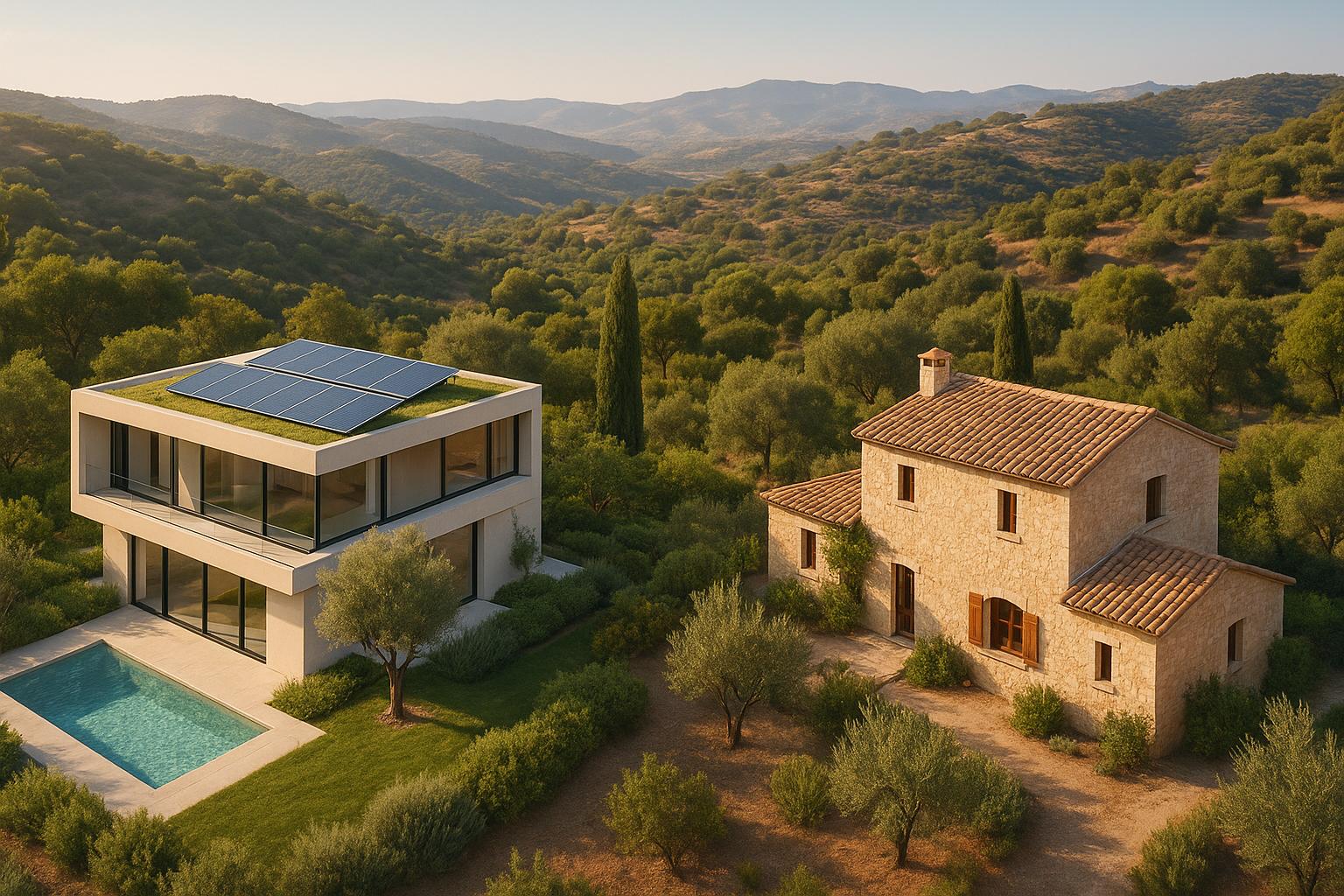
Choosing between eco-friendly villas and traditional homes in Cyprus comes down to costs, energy efficiency, and lifestyle priorities.
Here’s the core difference:
- Eco-friendly villas: Modern designs with solar panels, energy-efficient systems, and lower utility bills. They cost 10–20% more upfront but save up to three times on energy use annually. They’re future-focused, aligning with EU energy goals.
- Traditional homes: Offer charm with stone walls and clay-tiled roofs but lack modern efficiency. They often need costly upgrades to meet energy standards, raising maintenance expenses over time.
Key Points to Consider:
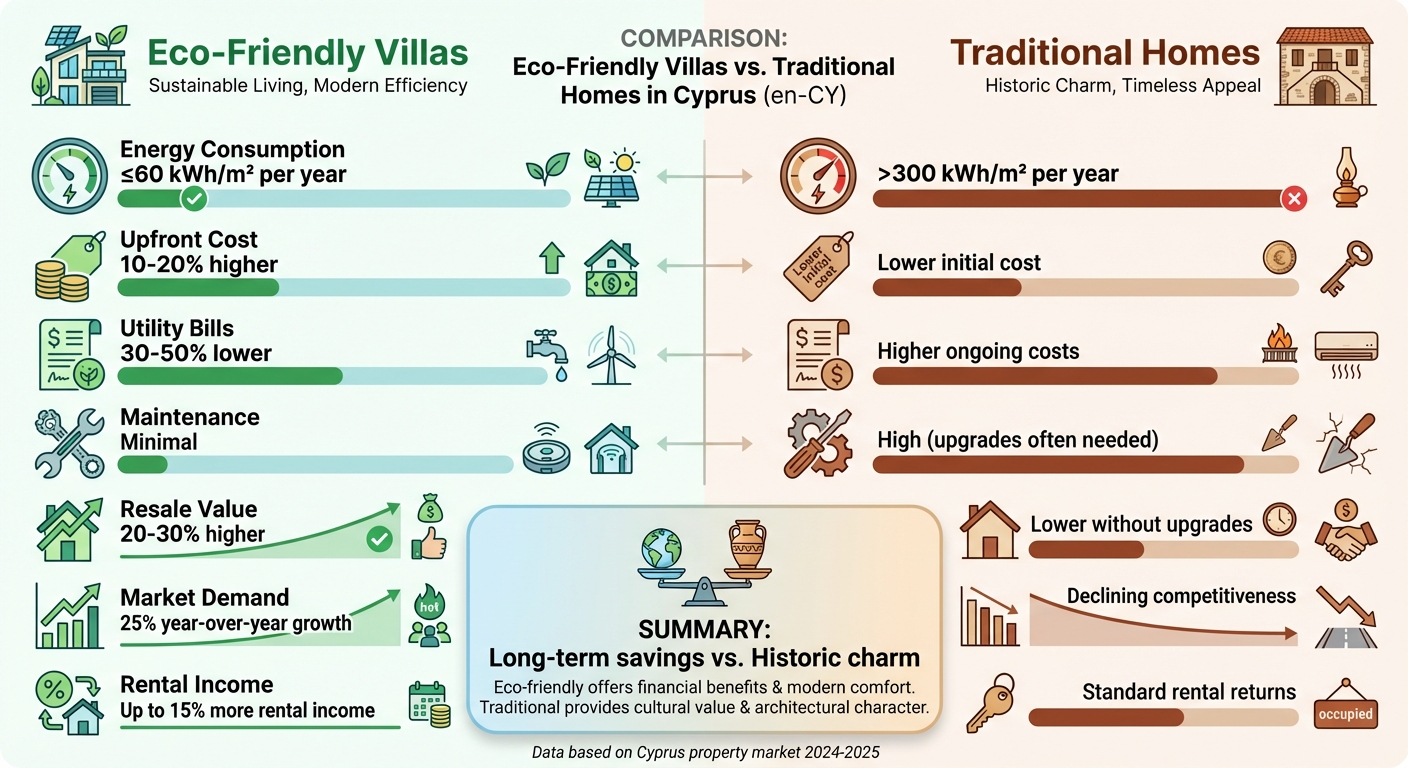
- Energy Use: Eco-friendly villas consume as little as 60 kWh/m² annually, compared to over 300 kWh/m² for older homes.
- Operating Costs: Villas save 30–50% on utilities, while traditional homes may require upgrades costing thousands of euros.
- Market Trends: Demand for eco-friendly homes has grown by 25% year-over-year, with buyers favouring lower bills and greener living.
- Long-Term Value: Eco-friendly properties command 20–30% higher resale prices and attract higher rental income.
Quick Comparison
| Feature | Eco-Friendly Villas | Traditional Homes |
|---|---|---|
| Energy Use | ≤ 60 kWh/m² per year | > 300 kWh/m² per year |
| Upfront Cost | 10–20% higher | Lower |
| Utility Bills | 30–50% lower | Higher |
| Maintenance | Minimal | High (upgrades often needed) |
| Resale Value | 20–30% higher | Lower without upgrades |
| Cultural Appeal | Modern, efficient | Historic, charming |
If you’re looking for long-term savings and a future-ready investment, eco-friendly villas are the better choice. If you prefer historic charm and don’t mind renovation costs, traditional homes might suit you better.
Eco-Friendly Villas vs Traditional Homes in Cyprus: Cost and Energy Comparison
Eco-Friendly Villas in Cyprus
Main Features of Eco-Friendly Villas
Eco-friendly villas in Cyprus are thoughtfully designed to harmonise with the environment. Using bioclimatic principles, these homes maximise natural cooling and limit the need for air conditioning. Features like passive solar design help maintain a comfortable indoor temperature throughout the year, cutting down on energy use.
A key aspect of these villas is their reliance on renewable energy. Solar panels are a common feature, generating electricity year-round. Many properties also include energy-efficient appliances, LED lighting, reversible air conditioning units, and advanced energy management systems. A great example is Karma Developers‘ Alaya Eco Villas in Protaras, which boast an Energy Rating A.
Water conservation is another priority. These villas often feature rainwater harvesting systems for irrigation, greywater recycling for non-drinking purposes, and efficient fixtures to minimise water use. Construction materials are chosen with sustainability in mind, including reclaimed wood, recycled steel, and low-VOC paints. Green roofs, vertical gardens, and organic landscaping further enhance their integration into the natural environment. These thoughtful features not only reduce energy and water usage but also contribute to a more sustainable and cost-effective lifestyle.
Cost Savings and Operating Expenses
Thanks to their efficient design, eco-friendly villas are far less expensive to operate compared to traditional homes. Older homes often suffer from poor insulation and require frequent renovations, leading to higher energy bills and maintenance costs.
Solar panels, a common feature of these properties, significantly reduce electricity expenses while requiring little upkeep. In Pissouri, for instance, homes equipped with solar panels and hot water cylinders showcase how renewable technology can support day-to-day energy needs efficiently.
Investment Returns and Lifestyle Benefits
The demand for eco-luxury homes in Cyprus is on the rise, spurred by growing environmental awareness and attractive government incentives. Certifications like LEED and BREEAM, which evaluate a property’s environmental performance, add further appeal for international buyers.
These villas not only offer reduced operating costs but also attract buyers who value sustainable living without compromising on comfort. This combination of environmental benefits and modern amenities creates strong potential for rental income and long-term value growth. As energy-efficient technologies and renewable solutions become more common, eco-friendly villas are positioned to remain highly desirable in the property market.
Traditional Homes in Cyprus
Features of Traditional Cypriot Homes
Traditional Cypriot homes are a testament to generations of Mediterranean craftsmanship. Constructed with thick stone walls – often exceeding half a metre in thickness – these houses are typically made from local limestone or sun-dried earth blocks. This choice of materials provides natural insulation, keeping the interiors cool during the scorching summer months and warm during the chillier winter season [24,25,26,29].
A hallmark of these homes is the central courtyard, or avli, often paired with a semi-open arcade known as the iliakos. These features not only help with natural cooling but also serve as spaces for social gatherings, reflecting the communal lifestyle of traditional Cypriot culture [24,26,28]. The houses, usually one or two storeys high, have rooms that open directly onto the iliakos. Narrow doors, small ventilation holes above them, and shutters instead of glass windows are all clever design elements aimed at managing Cyprus’s intense summer heat. Inside, the craftsmanship continues, showcasing the enduring skills of local artisans [24,28].
Modernisation Costs and Requirements
Homes built before 1980 often fall short of modern energy efficiency standards [33,34]. Across Europe, the building sector accounts for about 40% of total energy consumption. With more than 80% of existing buildings still standing as of 2020, upgrading these structures to meet current energy standards has become increasingly urgent.
Modernising traditional homes involves significant costs. Owners need to retrofit insulation, install solar energy systems, and upgrade utilities to meet the Nearly Zero Energy Building (nZEB) requirements [31,33,34]. A 2015 study on a pre-1980 single-family house in Cyprus highlighted the considerable challenges in achieving these standards.
In addition to energy upgrades, maintaining traditional homes can be complex and costly, especially for features like swimming pools. While green technologies promise long-term savings, they often come with high initial costs, with payback periods ranging anywhere from 18 months to two decades in some cases. Professional engineering advice is essential to accurately estimate savings and ensure the most effective upgrades.
These challenges highlight the need for a careful balance between preserving the charm of traditional homes and managing the financial demands of modernisation.
Heritage and Aesthetic Appeal
Despite the challenges of modernisation, traditional Cypriot homes hold immense cultural and historical significance. Their designs reflect a blend of influences from Ancient Greeks, Phoenicians, Romans, Byzantines, and Venetians [13,26]. Many of these homes have been beautifully restored as part of Cyprus’s thriving agrotourism movement, with villages like Fikardou maintaining their authentic charm [24,28].
To support these efforts, the Government of Cyprus offers a Housing Incentive Scheme for Mountainous, Remote, and Disadvantaged Areas. This programme provides financial assistance to help preserve the traditional character of these regions. The timeless beauty of these homes has also inspired modern architects to incorporate elements of stone construction, particularly in rural and village settings.
Direct Comparison: Eco-Friendly Villas vs Traditional Homes
Environmental Impact and Energy Use
Buildings in the EU are responsible for around 40% of final energy consumption and produce 30% of carbon dioxide emissions. In Cyprus, many traditional homes, especially those built before modern insulation standards were introduced, suffer from poor insulation and lack energy-efficient systems. These older properties can use over 300 kWh/m² annually just for heating. On top of that, their outdated insulation often increases the energy needed for cooling during Cyprus’s hot summers.
Eco-friendly villas, on the other hand, are designed to meet Nearly Zero Energy (NZE) standards. These homes consume as little as 0–20 kWh/m² per year and generate ≥50 kWh/m² per year through renewable energy sources. This is made possible by features like integrated solar panels, wind turbines, high-performance thermal insulation, double-glazed windows, and energy-efficient LED lighting. For traditional homes, modern upgrades can cut energy consumption by more than 40%.
Water usage is another area where eco-friendly villas stand out. They often include systems like rainwater harvesting, greywater recycling, and water-saving fixtures, which can reduce water consumption by 20–40%. In contrast, most traditional homes lack these systems, adding strain to Cyprus’s already limited water resources.
Purchase and Operating Costs
The cost differences between eco-friendly villas and traditional homes are just as striking as their energy performance. While new eco-friendly properties can be priced up to 12% higher than standard homes, with Class A houses averaging 10% more than traditional ones, they offer significant long-term savings.
Energy-efficient homes can cut electricity and heating bills by 30–50%, while water-saving technologies can lower water expenses by 20–40%. Residents of Class A or B buildings often pay three times less for utilities compared to those living in older homes.
Traditional homes, while sometimes cheaper upfront, often require costly upgrades to meet NZE standards. Improvements like better insulation, solar panels, and updated utilities can involve significant expenses, with payback periods ranging from 18 months to 20 years. On the other hand, green buildings tend to command 20–30% higher resale prices, making them attractive for buyers looking for long-term value.
Market Demand and Buyer Preferences
The Cypriot real estate market is clearly shifting toward sustainable living. In 2024, over 30% of new residential projects in Cyprus featured eco-friendly designs, a notable increase from just 10% in 2020. Demand for these properties has grown by 25% year-over-year, and surveys show that 70% of Cypriot homebuyers now prefer eco-friendly homes.
This growing demand is driven by factors such as increased awareness of climate change, the potential for lower utility bills, better property values, and healthier living conditions. Investors are also leaning toward sustainable properties, drawn by their reduced operating costs and appeal to tenants prioritising eco-conscious living. While traditional homes still attract buyers focused on affordability, the trend is unmistakably moving toward eco-friendly properties, which offer both financial and environmental benefits.
sbb-itb-f3a0c55
Long-Term Benefits for Property Investors
Property Value Growth and Rental Income
When it comes to long-term returns, eco-friendly villas stand out compared to traditional homes. These properties not only command 20–30% higher values but also generate up to 15% more rental income than their conventional counterparts. To put this into perspective, the average rental return for properties in Cyprus stood at 2.97% as of Q3 2025, with eco-friendly homes often exceeding this benchmark.
The growing popularity of sustainable living, combined with Cyprus’s rising tourism, has bolstered demand for eco-friendly properties. These homes tend to have higher occupancy rates, as both local and international tenants are drawn to their lower utility costs and environmentally conscious design. Meanwhile, traditional homes face mounting pressure to modernise if they wish to remain competitive in this shifting market.
Regulatory Changes and Market Shifts
The real estate market in Cyprus is undergoing a transformation, largely driven by the revised European Energy Performance of Buildings Directive (EPBD) introduced in April 2024. This directive sets ambitious goals: all new buildings must achieve “zero emission” status by 2030, with public buildings required to meet this target by 2028. Additionally, subsidies for standalone fossil fuel boilers will end in 2025, and these systems will be completely phased out by 2040.
Cyprus has also committed to reducing primary energy consumption by 16% by 2030 and 20–22% by 2035. To meet these goals, new building designs must incorporate renewable energy systems, ensuring at least 25% of energy consumption comes from renewable sources. Financial support is available through the “Green Energy Fund”, which covers up to 50% of costs for projects implementing sustainable energy solutions. Furthermore, mandatory energy audits and certifications for all new, rented, or sold properties are highlighting the growing performance gap between sustainable and traditional homes.
These regulatory shifts are reshaping the market, with energy-efficient properties becoming increasingly attractive to buyers and tenants alike. However, the impact on property value varies depending on the type of home.
Risk Factors and Property Resilience
Eco-friendly villas are naturally better equipped to handle rising energy costs. Their built-in renewable energy systems reduce operational expenses and minimise reliance on external resources, making them less vulnerable to fluctuations in utility prices.
In contrast, traditional homes face unique challenges. Many older properties, built before current energy efficiency standards, require significant and often costly upgrades to comply with evolving regulations. Failure to meet these standards could lead to devaluation, as buyers and tenants increasingly favour energy-efficient options. While well-maintained traditional homes may still appeal to those seeking authentic Cypriot charm, the financial burden of retrofitting these properties to meet net-zero standards can vary widely, depending on their condition. This makes long-term planning crucial for owners of older homes.
What are they like, exclusive villas in Cyprus? An interview with the architect of the project
Conclusion
Deciding between eco-friendly villas and traditional homes in Cyprus ultimately depends on your priorities – whether they lean towards investment returns or lifestyle preferences. Eco-friendly villas not only enhance property values by 20–30% but also generate up to 15% more rental income compared to traditional homes. On top of that, they can reduce utility bills by as much as 30%. These benefits, combined with lower running costs and high market demand, make them a strong contender for long-term financial gains. Built to accommodate future needs with minimal upgrades, they align seamlessly with the growing shift towards sustainable living.
On the other hand, traditional homes offer the undeniable charm of Cypriot heritage and come with lower initial costs. However, they often require substantial modernisation to stay competitive in today’s market. Without these updates, their value may decline as buyers and tenants increasingly favour energy-efficient properties. For those who cherish authenticity and character, traditional homes can still be a rewarding option – provided you’re ready to invest in upgrades and accept a slower rate of property value appreciation.
These contrasts highlight a broader shift in the property market. If your primary goal is to maximise returns and secure a future-ready investment, eco-friendly villas present a stronger case. In fact, by 2024, over 30% of new residential projects in Cyprus incorporated eco-friendly designs, a significant rise from just 10% in 2020. No matter your property aspirations, understanding these distinctions will help you choose a path that aligns with both your financial goals and personal lifestyle.
FAQs
What are the financial advantages of owning an eco-friendly villa in Cyprus over time?
Investing in an eco-friendly villa in Cyprus can be a smart financial move with benefits that extend well into the future. These properties often deliver steady rental returns, typically between 3.5% and 5%, making them appealing for both short-term and long-term rental markets. On top of that, their energy-efficient construction helps keep utility and maintenance expenses low, translating into consistent savings for owners.
Cyprus actively promotes sustainable living through government grants and tax breaks, which can boost the profitability of owning an environmentally-friendly home. Over time, these villas tend to see value growth, especially as the demand for green luxury real estate continues to rise.
What makes eco-friendly villas more energy-efficient than traditional homes in Cyprus?
Eco-friendly villas are built with the goal of cutting down energy use. They often include advanced insulation to keep indoor spaces comfortable by maintaining stable temperatures. Their energy-conscious layouts are designed to make the most of natural light and airflow, reducing the need for artificial lighting and air conditioning.
Many of these homes also incorporate renewable energy systems like solar panels to produce electricity, which can significantly reduce energy bills. Beyond being kinder to the environment, these features offer long-term savings, making them appealing to both homeowners and investors in Cyprus.
What are the main challenges in upgrading traditional Cypriot homes to meet modern energy standards?
Upgrading older Cypriot homes to align with modern energy standards isn’t always straightforward. Many of these traditional properties come with aging infrastructure, which often isn’t equipped to handle the two-way power flow that renewable energy systems, like solar panels, demand. This can be further complicated by issues such as voltage instability in certain areas and the absence of proper energy storage solutions, which limits the efficient use of renewable energy.
Another hurdle is the expense of retrofitting. Bringing these homes up to date often involves major renovations, such as improving insulation, replacing outdated systems, and incorporating energy-efficient technologies. On top of that, the local grid’s capacity can sometimes pose a problem. In some cases, excess solar energy generated by these systems may go unused due to grid limitations, which ultimately impacts the overall effectiveness of renewable energy installations.




 +
+ claudia@karmadevelopers.com.cy
 16 Kennedy Avenue (Kapparis), Paralimni