
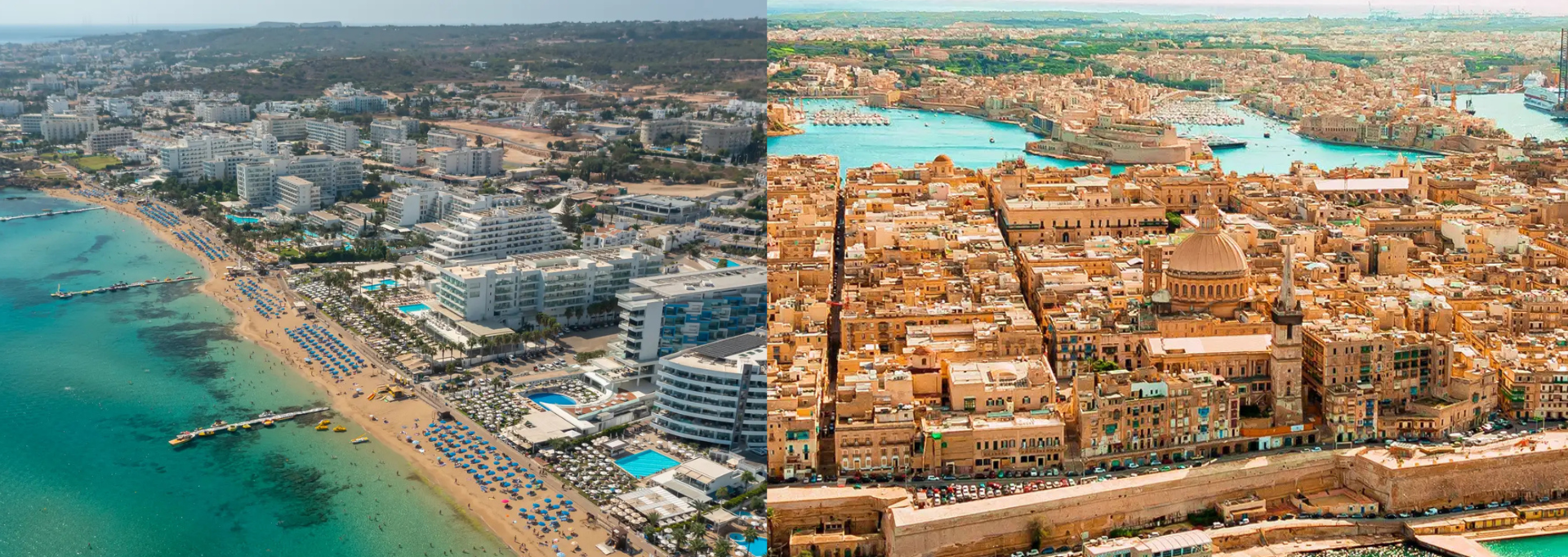
Cyprus and Malta are often compared in the same breath. Both are English-speaking, EU-member, Mediterranean islands with sunshine, sea and centuries of history. Both attract international buyers and relocators. Both are routinely on lists of attractive places to live in Europe.
But beyond the surface, these are very different places. They suit very different people. Choosing well is a matter of understanding where the differences actually live.
Below is an honest, side-by-side comparison written for the buyer or relocator weighing both options.
Size and Space
This is the first and most underrated difference. Cyprus is the third largest island in the Mediterranean, with a land area of around nine thousand square kilometres and a population of just over one million. Malta is around three hundred square kilometres with around half a million people.
The practical consequence is significant. Cyprus has space — long coastlines, open countryside, mountain ranges, low-density villages, room to drive somewhere new every weekend. Malta is denser, more urban, more contained. Many buyers describe Cyprus as feeling like a small country and Malta as feeling like a large city with a coastline.
If you are coming from a major capital and craving room to breathe, Cyprus tends to fit. If you want walkable density, an evening stroll into the centre, and your daily life inside a few square kilometres, Malta may suit you better.
Climate
Both islands are warm. Cyprus has slightly hotter, drier summers and slightly cooler winters than Malta, particularly inland. Cyprus also has the Troodos Mountains, which receive snow most winters and offer a genuine alpine contrast within a 90-minute drive of the coast. Malta does not have meaningful elevation or seasonal variety.
Annual sunshine hours are similar. Both islands are dry in summer, with most rainfall concentrated in November to February.
Language
English is widely spoken on both islands, which is the single most attractive feature for international relocators in both cases. The difference is that in Malta, English is an official language alongside Maltese, and is used in government, business and education by default. In Cyprus, the official languages are Greek and Turkish, but English is so ubiquitous in healthcare, legal services, business and daily life that most buyers can settle without speaking Greek.
For most relocators, both islands feel equally easy to operate in English. Maltese is closer to Arabic in structure than to any European language and is functionally optional for newcomers. Greek is more accessible if you want to learn it, but again not required.
Legal System
Both islands have legal systems influenced by English common law. Cyprus’s framework is more directly inherited from the British administration, with property contracts, court procedures and commercial law that feel very familiar to British, Irish and Commonwealth buyers. Malta’s system is mixed — Italian-influenced continental law underpins much of the civil and commercial framework, with common-law influences layered on top.
For property buyers, both systems are predictable, but Cyprus tends to feel more straightforwardly British in its property dealings.
Cost of Living
Cyprus is generally less expensive than Malta for the equivalent lifestyle, particularly in property, dining out and household services. Malta has become notably expensive in recent years, with property prices in central areas rising sharply as demand has outpaced supply on a much smaller island.
Both are more affordable than London, Paris or Amsterdam, but the gap is wider in Cyprus’s favour.
Property and Space per Euro
This is where the size difference shows up most clearly. In Cyprus you can buy a four-bedroom villa with a private pool and a generous plot, ten minutes from the sea, for a price that in Malta would buy a substantially smaller apartment in a central area.
If your priority is space — outdoor living, gardens, swimming pools, room for a family — Cyprus is the more comfortable choice. Malta is structurally short of building land, which keeps prices high and plots small. Karma’s current developments along the East Coast illustrate the kind of space available in Cyprus for the budgets buyers tend to bring to Malta.
Healthcare
Both islands offer high-quality healthcare. Malta’s public system has been highly rated by international comparisons for years. Cyprus introduced its national health system GESY in 2019, and the standard of care, particularly in private hospitals and clinics, is high. Both have strong English-speaking medical communities.
For most buyers, healthcare is not the deciding factor between the two.
Schools
Both islands have well-established international schools offering British, American and IB curricula. Malta’s denser geography means schools are closer together. Cyprus has more space and more campus-style schools with playing fields, pools and outdoor activities — which appeals to many relocating families.
Connectivity
Malta is closer to mainland Europe than Cyprus, with a wider selection of low-cost flights and shorter flight times to Italy, France, Spain and the UK. Cyprus is further east, with longer flight times to most of Europe but excellent direct connectivity to London, the Middle East, Israel, Greece and the wider region.
If your travel is mostly Western European, Malta has an edge. If your travel includes the Middle East or you value a position closer to Israel, Egypt or the Gulf, Cyprus is clearly better placed.
Lifestyle and Culture
This is the most subjective comparison, and the most important one.
Cyprus has a slower, more rural-village feel, even on its coasts. Long lunches, big family gatherings, mountain villages, vineyards, beaches with space to spread out. The pace is unhurried. Outdoor living dominates.
Malta is denser, more urban, more pedestrian. Daily life often happens on a smaller geographic scale — walking to your café, walking to your gym, walking to dinner. Cultural attractions are tightly packed, and the historical density is remarkable for an island its size.
Neither is better. They suit different temperaments.
Outdoor Space and Nature
Cyprus wins on nature. Hundreds of kilometres of coastline, mountains, hiking trails, wine country, protected peninsulas, forests, beaches with room to breathe even in August. Malta has spectacular coastal scenery but is much more limited in scale.
If hiking, cycling, sailing across long distances, weekend mountain trips and a sense of being able to escape are important to you, Cyprus offers more.
Pace of Life
Cyprus runs slower. Malta runs faster, especially in central districts. Both are calmer than London or New York, but if you are seeking the more pronounced shift, Cyprus delivers it.
Who Each Island Suits
Cyprus tends to suit families wanting space, retirees, anyone seeking a quieter rural-coastal rhythm, buyers who want a villa with a garden and a pool, anyone with regular travel to the Middle East, and remote workers who want lifestyle for less.
Malta tends to suit younger professionals, urban-loving relocators, anyone who values walkability over space, frequent travellers to Western Europe, and buyers comfortable with apartment living in dense neighbourhoods.
Many relocators visit both before deciding. We strongly recommend it. Both are honest islands, and what each offers becomes clear within a few days on the ground.
See Cyprus for Yourself
If Cyprus is on your shortlist and you would like to spend time on the East Coast — the quieter, more spacious side of the island — we would be glad to help you plan a visit and see what life here actually looks like.
For an introduction to the island, see our Discover Cyprus guide. For non-EU citizens exploring long-term settlement, we have a dedicated page on permanent residency pathways.
Curious about Cyprus? Speak with the Karma team about a visit, or browse our current developments.





 +
+ claudia@karmadevelopers.com.cy
 16 Kennedy Avenue (Kapparis), Paralimni