
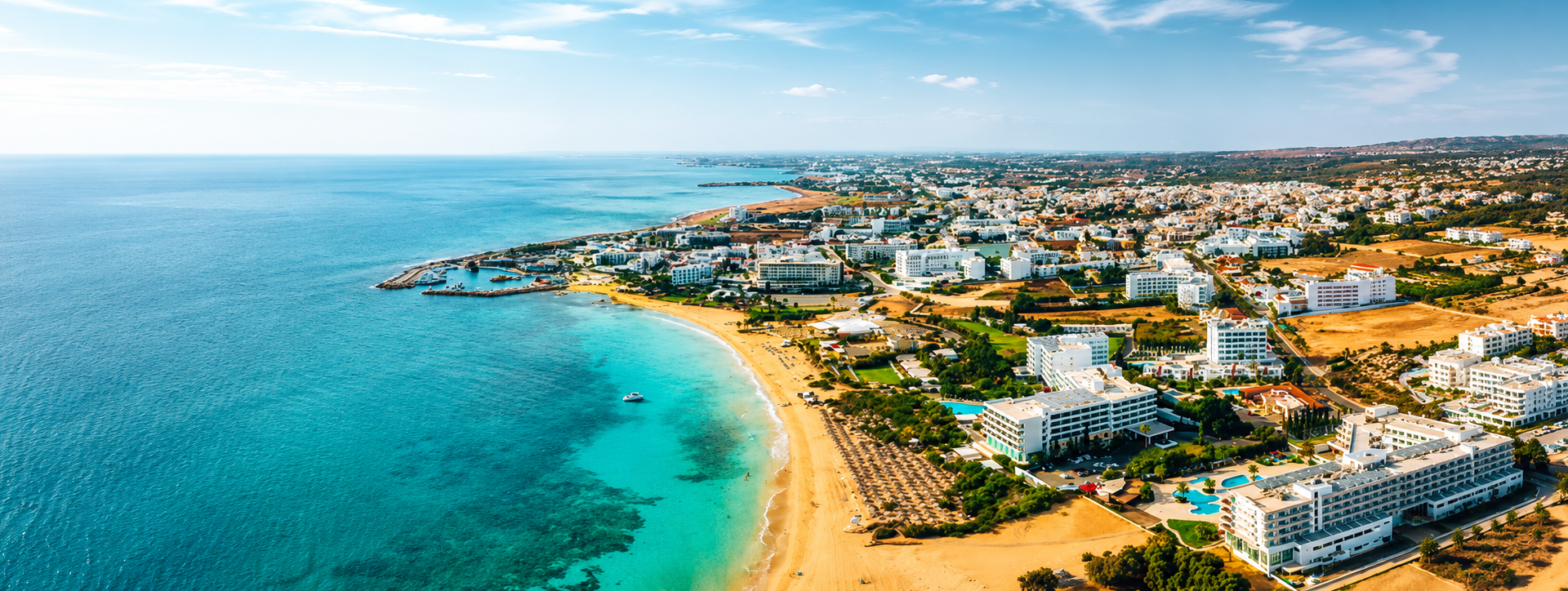
Paralimni is the unofficial capital of the Famagusta district — a working town that swells in summer with holidaymakers and quietly resumes its own life from October to April. For relocators considering East Cyprus, this winter version of Paralimni is the one that matters most. The summer is the festival. Winter is what you actually live in.
If you are thinking about buying or moving to the area, here is what to expect from Paralimni between the months when the beaches go quiet.
A Town That Stays Awake Year-Round
Paralimni is not a coastal resort that closes its shutters in October. It is the administrative and commercial centre of the region, home to schools, hospitals, government offices, supermarkets, banks, courts and the kind of everyday infrastructure that makes year-round living straightforward.
The town centre — clustered around the main square, the church of Agios Georgios and Eleftherias Street — operates on full speed all winter. Cafés serve coffee from seven in the morning. Bakeries open before sunrise. Schools run, shops trade, doctors see patients.
Everyday Essentials You Can Count On
The major supermarkets in Paralimni operate year-round and most stay open seven days a week, with reduced Sunday hours. You will find familiar European brands alongside Cypriot staples. The town also has a network of smaller mini-markets and traditional grocers, several of which have been in the same family for decades.
Banks, post offices, pharmacies, opticians, dental clinics and veterinary surgeries are all present in the centre or along the Paralimni–Deryneia and Paralimni–Sotira axes. Healthcare in the wider Famagusta district is well-served, with English-speaking specialists available.
Cafés, Tavernas and Restaurants That Operate All Year
The cafés around the main square and along the high street are open year-round and have a noticeable local character in winter — fewer tourists, more retirees reading newspapers, more groups of friends playing tavli at the back tables.
Traditional Cypriot tavernas run all winter, often with a roaring fire and a smaller, more seasonal menu — slow-cooked stews, lamb, ofto, pulses, grilled halloumi, oranges from local trees. International restaurants — Italian, Lebanese, Asian — are well-represented too, and most of the year-round venues are clustered in the centre rather than along the beach strip in nearby Protaras, which thins considerably from November.
A simple rule: in winter, follow the local cars. If a taverna’s car park has plates from Paralimni, Deryneia and Sotira on a Wednesday evening, it is open and it is good.
A Weekly Rhythm Worth Knowing
Paralimni’s open-air market runs weekly on a fixed day, year-round, in the town centre — fruit, vegetables, eggs, cheese, olives, breads, household goods. It is the unofficial gathering point of the town. Saturday mornings see locals doing weekend errands, school children at football and tennis lessons, families lingering at coffee.
Sundays revolve around church in the morning, family lunch in the early afternoon, and an evening walk along the seafront in nearby Protaras or Pernera if the weather is good. Cyprus winters are mild enough that an outdoor coffee in February is normal, not unusual.
Healthcare, Schools and Family Life
The town has a strong network of nursery schools, primary schools and secondary schools — both public and private — that run on the standard September-to-June academic calendar. Several international curricula are available within the wider Famagusta district.
For day-to-day medical needs, family doctors operate from clinics across the town, with most accepting both GESY and private patients. Pharmacies follow a rotating night-and-weekend duty roster posted at the front of every pharmacy door.
Sport and Fitness in Winter
Gyms, padel courts, tennis clubs, swimming pools, dance studios and pilates studios all operate year-round. Paralimni and the surrounding villages also have a strong amateur football culture, walking and cycling groups, sailing clubs along the coast, and yoga groups that have grown noticeably in recent years.
For outdoor sports, winter is in many ways the best season. The coastal walking trails between Paralimni, Cape Greco and Protaras are pleasant in 16-degree January sunshine, and sea swims — yes, even in February — are part of the routine for a growing number of residents.
Winter Weather, Honestly
Paralimni winters are mild. Daytime temperatures from December to February typically sit between thirteen and eighteen degrees, with cool evenings and occasional rain. The wettest months are December and January, and even then total rainfall is modest. Snow is essentially unheard of. Most days, an outdoor jumper and a light jacket are enough.
This climate is one of the quiet reasons Paralimni works as a year-round home: there is no point in the calendar when the town shuts down because it is too cold or too wet.
Community Events and the Church Calendar
Paralimni’s social calendar runs to the rhythm of the Greek Orthodox church and Cypriot folk traditions. Christmas, New Year and the Twelfth Night are major moments. Greek Orthodox Easter — typically in April or May — is the largest event of the year, with processions, fireworks, fasts, feasts and a town that turns inside out for a week.
In between, the town hosts cultural evenings, school concerts, charity events, sports tournaments and the usual events of any town that values its community.
A Realistic January Weekend
If you want a sense of what life in Paralimni feels like off-season, here is a typical January weekend.
Saturday morning: coffee at a café on the main square, a walk to the bakery for fresh bread, a swing through the weekly market for vegetables and olives. Late morning: a drive to the coast for a winter sea view and a long lunch at a taverna in Pernera or Protaras. Afternoon: a walk along Konnos Bay or Cape Greco. Evening: drinks with friends at a local bar in the town, then home.
Sunday morning: church for some, a slow start for others. Family lunch. Evening: a film at home, a walk, an early night.
It is not a town that needs to entertain itself dramatically. It simply lives.
Why This Matters for Buyers
The most common mistake buyers make in East Cyprus is judging the region by August. August is the festival. The real decision is whether you would want to live here in February — and Paralimni is one of the few towns on the coast where the answer, comfortably, is yes.
If you would like to spend a day or two in Paralimni and see it for yourself, we are happy to help organise your visit.
Plan a visit. Speak with the Karma team about exploring the area, or browse our developments around Paralimni and the East Coast.





 +
+ claudia@karmadevelopers.com.cy
 16 Kennedy Avenue (Kapparis), Paralimni